AI Adoption Strategy: Inside and Outside the Business
Feb 13, 2026
|
6
min read
You have already started, now make it two-sided
If you are using a tool like MeetMinutes, you are already ahead of most teams. Congrats, you have invested in serving your internal team properly, and that is where real execution starts.
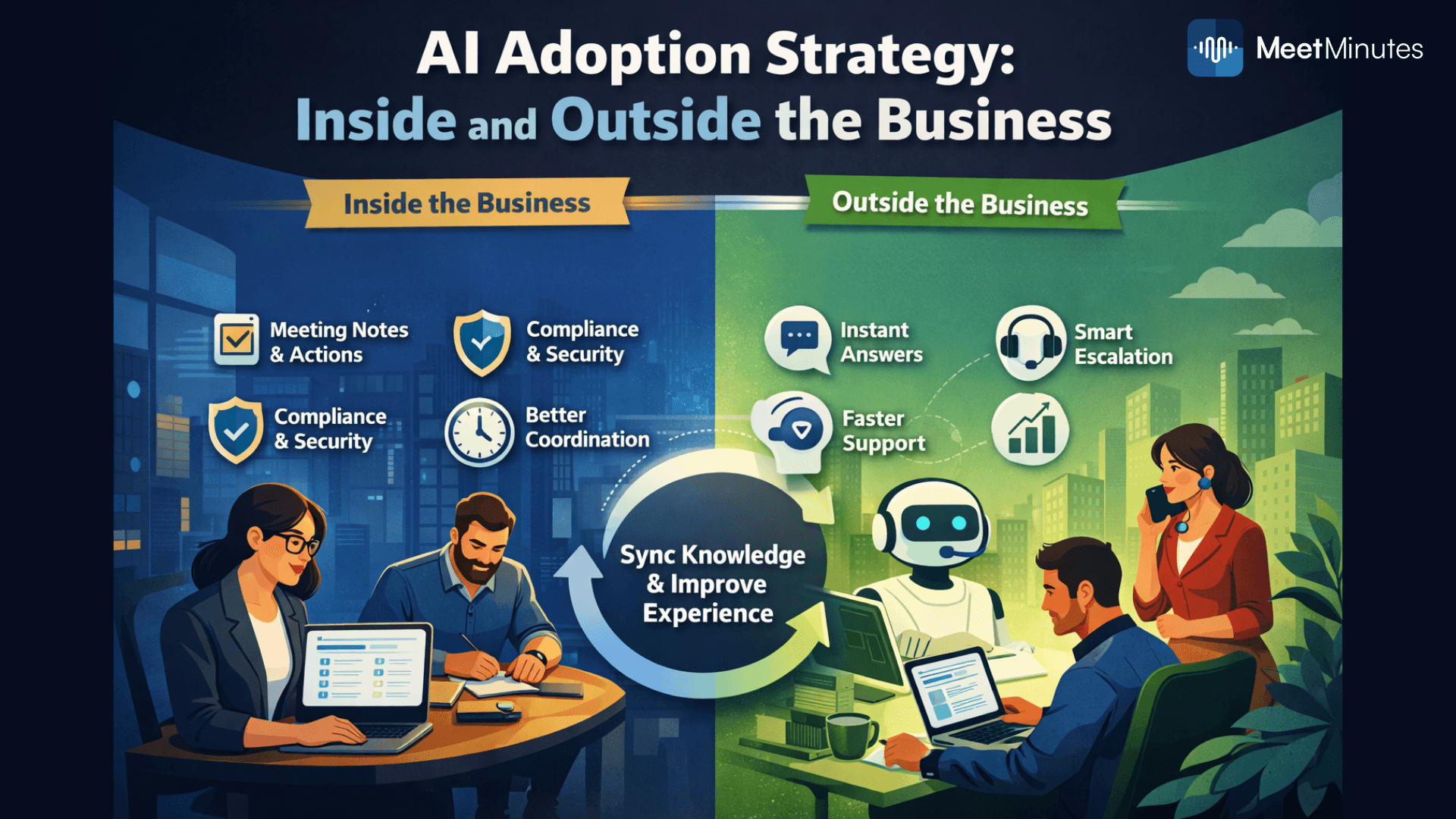
Now the opportunity is to expand your AI adoption strategy into a two-sided system: keep strengthening how your team runs internally, and add customer-facing AI so the outside of the business gets faster, more consistent service too.
Not because meeting AI is lacking, but because the strongest operators apply AI where coordination waste and customer demand overlap.
The real cost of staying manual, inside and outside
Growing teams usually feel two pressures at the same time:
Inside: too many meetings, too many threads, unclear ownership, follow-ups that slip.
Outside: too many repeat questions, slow first responses, support coverage gaps.
If you improve only internal coordination, customers can still queue up outside your door. If you focus only on external support, your internal execution remains noisy and reactive. Doing both creates a compounding effect: internal clarity improves what customers experience, and customer questions expose where internal knowledge is missing.
A practical question I ask founders: where are you losing more time this week, meetings or customer questions? If the answer is “both”, you are the target audience for two-sided adoption.
Internal AI: where MeetMinutes helps most
MeetMinutes is a strong example of internal AI done in a practical way, and it gets several important things right:
It treats AI as a pre and post meeting workflow, not just a transcript generator.
It takes multilingual reality seriously, including mixed languages and dialects where accuracy matters.
It recognises compliance and data protection as core buying requirements.
Based on my experience, meeting intelligence helps most in three moments:
1) Before the meeting: sharper input, less drift
A lot of meeting waste comes from missing context. When people arrive without shared framing, you burn time re-explaining and re-arguing. Strong meeting prep reduces that.
2) During the meeting: capture decisions, not just words
Transcripts are useful, but decisions are the real asset. Capturing what was decided, what risks were raised, and who owns the next step creates clarity, especially across distributed teams.
3) After the meeting: follow-through that sticks
The goal is momentum. If action items and owners are clear, you reduce the “wait, what did we agree?” loops and you move faster with fewer check-ins.
Here is the trade-off I have learned: internal meeting AI delivers the biggest payoff when it strengthens follow-through and accountability, not when it produces nicer summaries.
The natural next step: serve outside the business too
Once the inside is running tighter, the next logical place to apply AI is customer-facing support.
Why? Because repetitive customer questions are a silent tax. They pull founders and operators into reactive mode, and they create customer frustration when response times slip.
Customer-facing AI, implemented with guardrails, helps by:
Answering common questions instantly (how-to, setup, policies), including after-hours.
Reducing repeat tickets so humans focus on edge cases and higher-stakes issues.
Routing faster by collecting context and escalating cleanly when needed.
The important nuance is this: the aim is not to “replace support”. The aim is to handle the predictable queries reliably, and escalate the risky ones to humans.
Ask yourself: which five questions does your team answer every day, and how safe would it be to automate the first response?
The operating model: knowledge → automation → handover → measurement
This is where teams win or lose. Tools are the easy part. The operating model is the hard part.
Knowledge
AI quality is capped by your knowledge quality. You need a source of truth with clear ownership.
What sources can the AI use?
Who updates those sources when things change?
What is sensitive and should never be used?
Automation
Start with low-risk, high-volume questions. Avoid the temptation to automate edge cases early, because that is where trust breaks.
Handover
Define escalation rules for billing, security, account access, compliance requests, and anything ambiguous. Make sure the handover path is staffed, otherwise “escalation” is just a nicer word for a dead end.
Measurement
Track what matters: deflection on common questions, escalation rates, resolution times, and the categories where the AI fails. Every failure is a content gap you can fix.
A simple mindset shift: treat your knowledge like a product. It needs maintenance, owners, and feedback loops.
A simple adoption plan in 30–60–90 days
Days 1–30: pick two narrow pilots
One internal workflow: meeting capture plus action tracking.
One external workflow: the top 20 customer questions by volume.
Define “safe to answer” and “must escalate” categories.
Days 31–60: build the knowledge loop
Turn recurring meeting decisions into updated docs, playbooks, and help articles.
Review support conversations weekly and patch gaps.
Expand only where you can prove the answers are grounded.
Days 61–90: connect decisions to customer outcomes
Use meeting outputs to drive documentation updates and customer comms.
Use support patterns to prioritise product fixes and clearer onboarding.
Measure improvements in first response time and escalation quality.
If your team does one thing right, make it this: start narrow, get the loop working, then scale what proves itself.
Tooling example: MeetMinutes inside, customer AI outside
A concrete pairing looks like this:
Use MeetMinutes to capture multilingual notes, decisions, and action items.
In parallel, deploy a customer-facing AI agent trained on your approved content, with clear escalation to humans for sensitive topics.
Use analytics from customer conversations to identify gaps in docs, onboarding, and product UX.
Feed those insights back into internal meetings, where decisions are made and owners are assigned.
Update the knowledge base so both the team and customers get better answers next week than they got last week.
If you want a single example of a platform in this category, Mando AI is one option for customer-facing support: an AI agent trained on your content, deployed to customer channels, with human handover when needed.
Common pitfalls and how to avoid them
Set-and-forget thinking: assign owners and review cadence, or quality decays.
Automating high-stakes questions too early: start with low-risk queries, escalate the rest.
No handover design: define escalation rules and make sure someone catches them.
Over-claiming compliance: compliance differs by region and industry, validate against your own requirements.
Measuring vibes, not outcomes: track deflection, escalation quality, and content gaps.
Mini checklist to use this week
We have a clear internal workflow for capturing decisions and owners.
We know our top 20 customer questions by volume.
We have a maintained source of truth for customer answers.
We have escalation rules for sensitive and ambiguous issues.
We review outcomes weekly and update knowledge accordingly.
Conclusion: serve your team, then serve your customers
A strong AI adoption strategy starts by serving your internal team, and MeetMinutes is a solid example of internal AI done well. The next compounding move is to serve outside the business too, with customer-facing AI that is grounded in your knowledge, escalates to humans when needed, and improves through measurement.
This month, pick one internal workflow and one external workflow. Pilot both. Build the knowledge loop. Then scale what works.
👉 Try MeetMinutes free
https://app.meetminutes.in
👉 Book a Demo (Optional)
https://calendly.com/support-kduy/30min